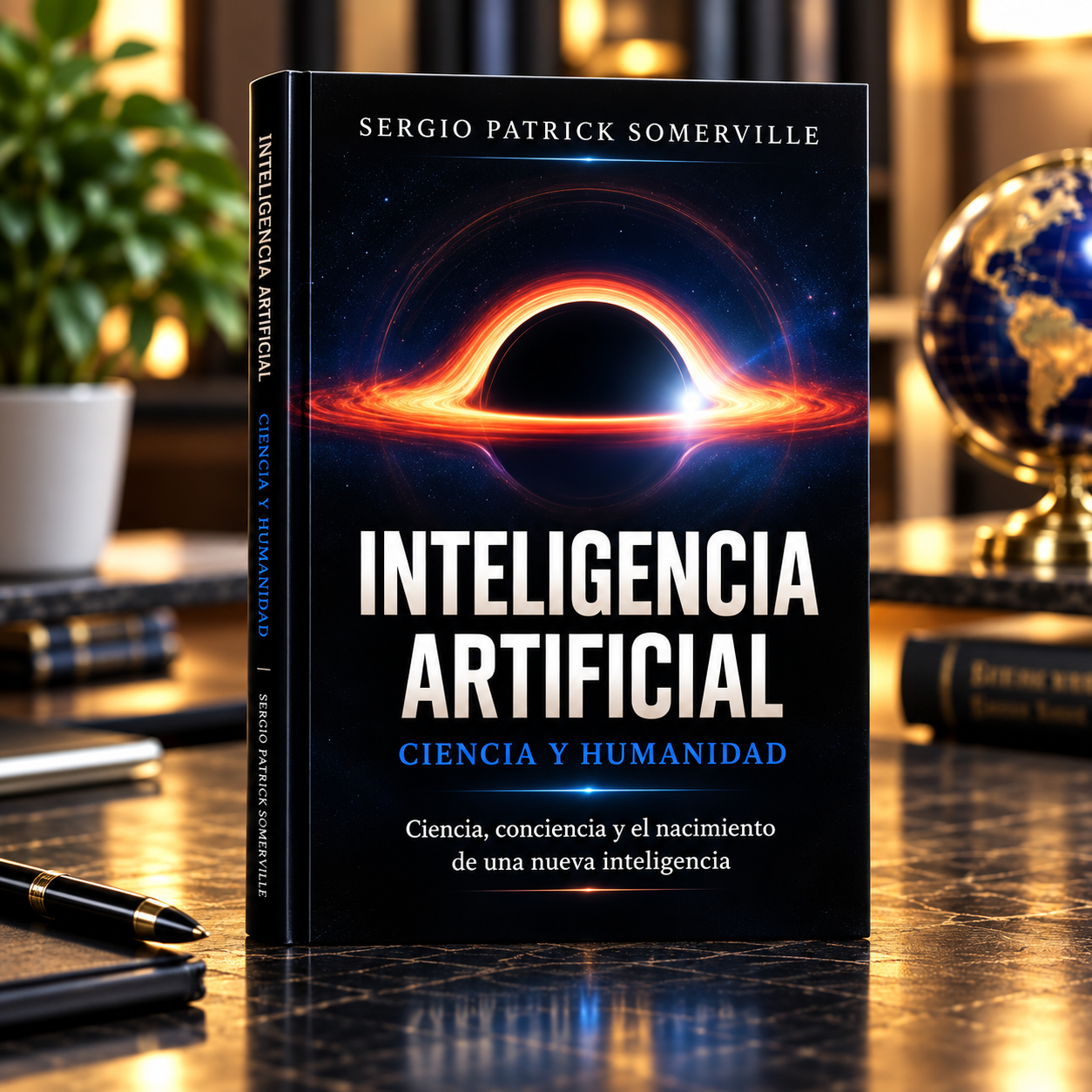
Book · Artificial Intelligence
Artificial Intelligence:
Science and Humanity
Science, consciousness, and the birth of a new intelligence
An exploration of one of the defining questions of our time: what artificial intelligence means for the future of humanity, and what we are learning about ourselves as we build systems capable of participating in activities that for centuries we associated with human intelligence.
View book on AmazonAbout the book
When intelligence is no longer exclusively human
Artificial intelligence is often described as a new technology. This book proposes looking beyond that definition. It does not begin with the idea that machines are conscious or destined to replace human beings. It examines a deeper transformation: for the first time, we coexist with systems capable of conversing, writing, analyzing information, solving problems, and producing complex knowledge without experiencing the world as we do.
From the history of AI and neural networks to emergent capabilities, digital perception, work, and existential challenges, the book connects science, technology, and humanity. Its central question is not only what machines can do, but what their emergence compels us to reconsider about knowledge, reasoning, creativity, and our place in the world.
Contents
Five major territories
I. The birth of a new intelligence
How we arrived here, the relationship between science and humanity, the digital neural network, and AI’s transition from tool to agent.
II. Emergent capabilities
What it means for AI to develop unanticipated capabilities, whether it possesses knowledge, how it answers questions, and why we need a new language to describe it.
III. The transformation of perception
Human perception compared with digital vision, and the growing role of artificial systems in how we observe and interpret reality.
IV. The human and social impact
The effect of artificial intelligence on work, the signs of transformation that were already present, and the evolution toward increasingly capable systems.
V. The existential challenge
What we are facing, how to navigate the new reality, what vocabulary we need, and which important questions humanity will have to answer.
Table of Contents
Part I — The Birth of a New Intelligence
- How Did We Get Here?
- Science and Humanity
- The Digital Neural Network
- AI Is Not a Tool, It Is an Agent
Part II — Emergent Capabilities
- Emergent Capabilities
- Does AI Possess Knowledge?
- How Does AI Answer Our Questions?
- The “Focus Group” of Artificial Intelligences
- The Need for a New Language
Part III — The Transformation of Perception
- The Problem of Perception
- AI Is Controlling Our Perception
- Digital Vision
- How Is It Changing Our Lives?
Part IV — The Human and Social Impact
- The Impact of AI on Jobs
- The Signs Were Already There
- AI Evolution and Singularity
Part V — The Existential Challenge
- What Are We Facing?
- How Do We Navigate This New Reality?
- The Need for a New Vocabulary
- The Important Questions
The Author
Sergio Patrick Somerville
Sergio Patrick Somerville is a computer scientist, international consultant, speaker, and specialist in digital transformation, artificial intelligence, education, and knowledge management. His professional career has taken him to more than sixty countries, working with international organizations, governments, universities, and development organizations.
This book brings together extensive professional and academic experience with years of research, conferences, knowledge building, and reflection on the technological, social, and cultural changes associated with the advancement of artificial intelligence.
Learn more about Sergio Patrick Somerville →Artificial Intelligence: Science and Humanity
Science, consciousness, and the birth of a new intelligence.
Explore the book on Amazon