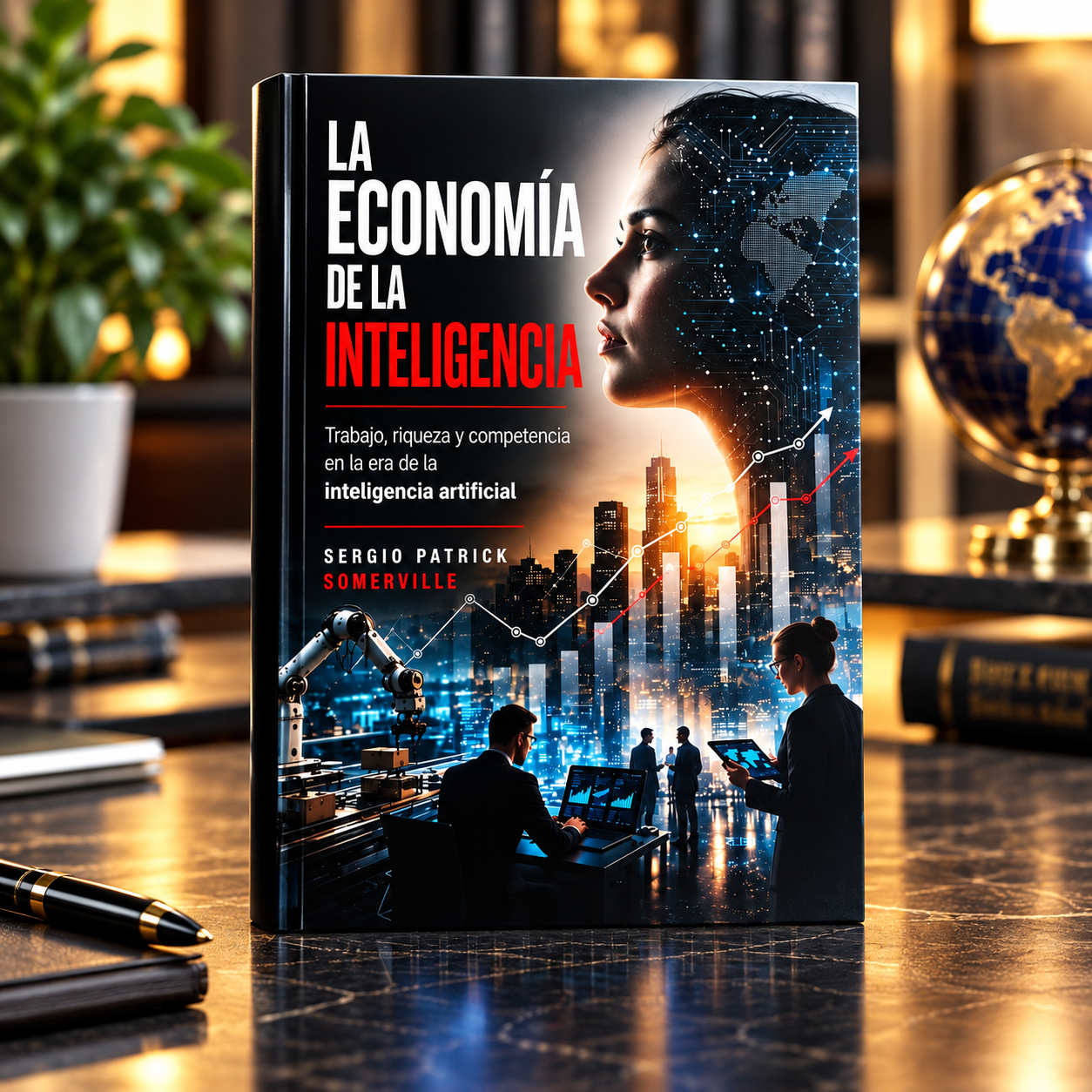
Book · Artificial Intelligence, Economy and Work
The Intelligence Economy
Work, wealth, and competition in the age of artificial intelligence
A look at the economic transformation that begins when intelligence ceases to be an exclusively human, scarce, and difficult-to-scale resource and starts becoming an accessible, distributed computational capability available on demand.
View book on AmazonAbout the book
What happens when intelligence is no longer scarce?
For much of economic history, specialized intelligence was one of the most difficult resources to produce and scale. Training physicians, engineers, researchers, lawyers, analysts, or strategists required years of education and experience. Organizations were built around that scarcity: hiring talent, organizing it, and coordinating it constituted an essential part of their competitive advantage.
Artificial intelligence is beginning to change that equation. Cognitive capabilities that once depended exclusively on professionals can now be incorporated into models, platforms, and agents capable of generating analysis, documentation, alternatives, and knowledge at a scale that was difficult to imagine only a few years ago. Intelligence is beginning to behave like a new economic infrastructure.
The Intelligence Economy examina las consecuencias de esta transición sobre el trabajo, la empresa, la productividad, la competencia, las naciones, la riqueza y la distribución del poder. Su pregunta central no es simplemente qué trabajos automatizará la IA, sino cómo cambia el sistema económico cuando la cognición misma puede producirse, distribuirse y combinarse con el trabajo humano.
Contents
Four transformations of the new economy
I. De la escasez a la infraestructura
La inteligencia deja de depender únicamente de expertos individuales y comienza a convertirse en una capacidad disponible bajo demanda. Modelos, plataformas y agentes forman una nueva infraestructura cognitiva para la economía.
II. Reconstrucción del sistema de producción
La IA emerge como un nuevo factor de producción y modifica la asignación del trabajo cognitivo. Empresas y profesionales evolucionan hacia sistemas híbridos donde personas y máquinas combinan capacidades complementarias.
III. Competencia, concentración y soberanía
La ventaja competitiva cambia cuando la inteligencia avanzada se vuelve ampliamente accesible. Empresas y países enfrentan nuevas preguntas sobre infraestructura, concentración tecnológica, riqueza, poder y soberanía.
IV. La cuestión humana
La transformación económica conduce finalmente a una cuestión humana: cómo aumentar nuestras capacidades con IA sin ceder el juicio, la responsabilidad y el control sobre las decisiones que definen nuestras organizaciones y sociedades.
Table of Contents
Parte I — De la escasez a la infraestructura
- El fin de la inteligencia escasa
- La inteligencia se convierte en infraestructura
- Los cuellos de botella de la abundancia
Part II — Reconstructing the Production System
- Intelligence as a Factor of Production
- The Great Cognitive Reallocation
- The Reorganization of the Firm
- The Rise of Human-AI Systems
Part III — Competition, Concentration, and Sovereignty
- The New Competitive Advantage
- Nations in the Intelligence Economy
- Wealth, Inequality, and Power
Part IV — The Human Question
- The Age of Augmented Humanity
- Keeping Humans in Command
Key Concepts
The New Rules of the Cognitive Economy
Inteligencia como infraestructura
Cognitive capacity begins to become a scalable service integrated into economic processes, comparable in structural importance to other major technological infrastructures.
Cognitive Reallocation
Intellectual work is redistributed between people and intelligent systems. Human value progressively shifts toward judgment, creativity, leadership, supervision, and coordination.
Human-AI Systems
The productive unit of the future will not necessarily be the person or the machine in isolation, but hybrid systems capable of combining human and computational intelligence.
The Author
Sergio Patrick Somerville
Sergio Patrick Somerville is a computer scientist, international consultant, speaker, and specialist in digital transformation, artificial intelligence, education, and knowledge management. Over more than four decades of professional experience, he has worked in more than sixty countries across Latin America, Africa, Asia, Eastern Europe, and North America.
Su experiencia combina tecnología, estrategia, políticas públicas, educación y transformación institucional. En The Intelligence Economy utiliza esa perspectiva interdisciplinaria para examinar la inteligencia artificial no solamente como tecnología, sino como una fuerza capaz de modificar la arquitectura económica sobre la cual se organizan el trabajo, la producción y la competencia.
Learn more about Sergio Patrick Somerville →The Intelligence Economy
Work, wealth, and competition in the age of artificial intelligence
Explore the book on Amazon