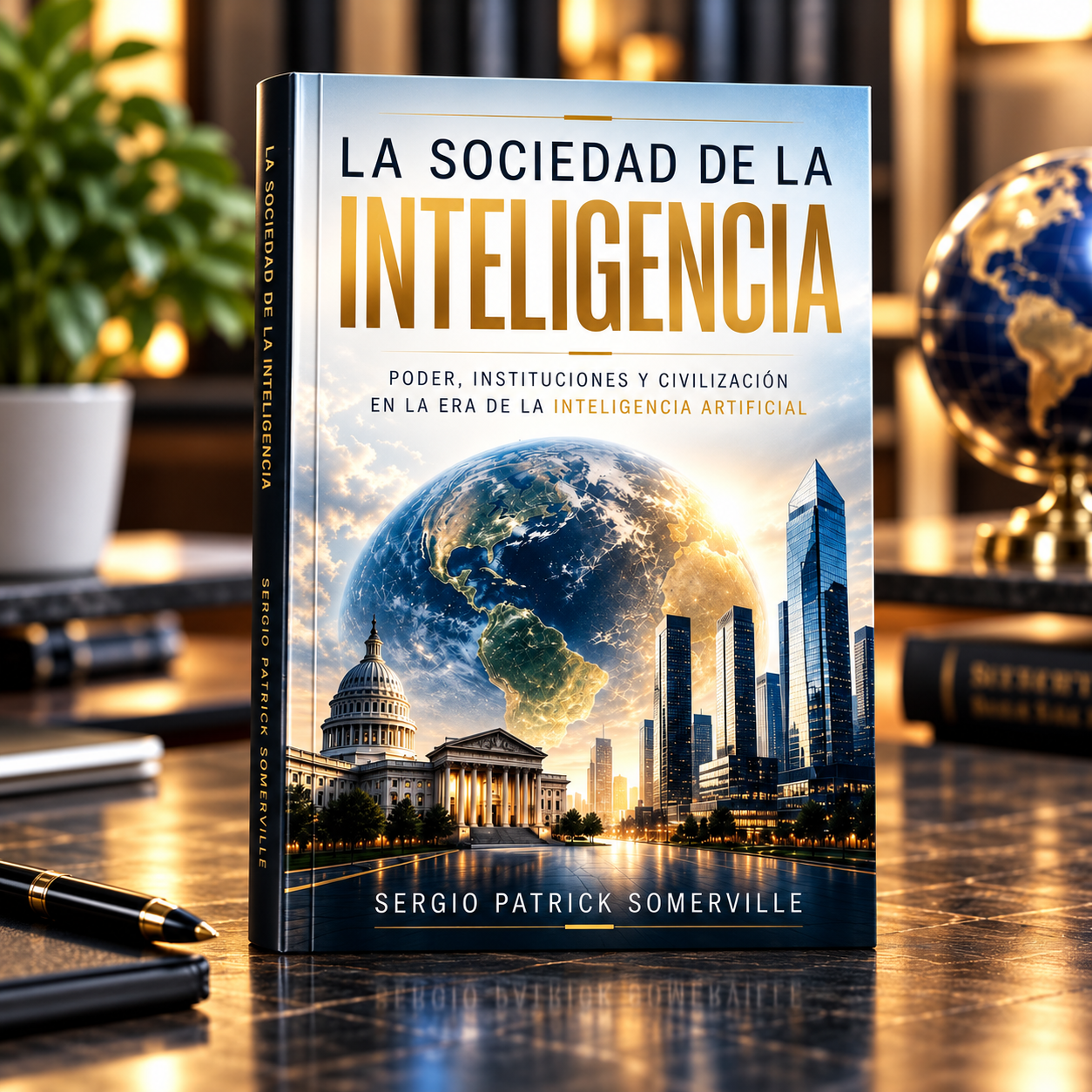
Book · Artificial Intelligence, Society and Governance
The Intelligence Society
Power, institutions, and civilization in the age of artificial intelligence
An exploration of what begins to happen when artificial intelligence ceases to be an isolated technology and starts to become integrated into the infrastructure, institutions, decisions, and systems on which society operates.
View book on AmazonAbout the book
What kind of society are we building around artificial intelligence?
Artificial intelligence is ceasing to be a technology used only for specific tasks. We converse with it, ask it to analyze information, write, program, interpret images, and help us think through decisions. It is entering businesses, universities, governments, hospitals, laboratories, and homes.
The deepest change, however, is not simply about expanding the list of things a machine can do. We are beginning to coexist with another form of intelligence and incorporate it into the way we work, learn, conduct research, organize institutions, and make decisions.
The Intelligence Society dirige la mirada hacia esa transformación. Examina la inteligencia artificial como infraestructura cognitiva, su incorporación a las instituciones, la aparición de nuevas formas de poder, los problemas de gobernanza y, finalmente, la sociedad que puede surgir cuando los seres humanos dejamos de ser la única fuente de inteligencia capaz de participar activamente en su funcionamiento.
The Transformation
Five Dimensions of the Intelligence Society
1. The Infrastructure of Intelligence
AI is beginning to move from the interface into processes. Models, agents, data, data centers, energy, and computing capacity form a new cognitive infrastructure on which organizations and services are beginning to be built.
2. Augmented Institutions
Businesses, governments, universities, hospitals, and other institutions are beginning to incorporate systems capable of analyzing information, retrieving knowledge, and participating in work and decision-making processes alongside people.
3. The New Power of Intelligence
When the capacity to produce and distribute intelligence depends on computing, data, energy, capital, and specialized knowledge, control over these resources can also become a new source of economic, institutional, and geopolitical power.
4. The Governance of Intelligences
As systems move beyond simply responding and begin to recommend, decide, or act, new questions emerge about permissions, oversight, accountability, traceability, and human control.
5. The Intelligence Society
The ultimate question is not merely technological. It is civilizational: how does a society change when it incorporates artificial intelligences into the structures through which it produces knowledge, organizes institutions, distributes power, and makes decisions?
Contents
Table of Contents
- The Infrastructure of Intelligence
- Augmented Institutions
- The New Power of Intelligence
- The Governance of Intelligences
- The Intelligence Society
- Conclusions
Key Concepts
From Tool to Social Infrastructure
Cognitive Infrastructure
AI no longer appears only when we call upon it and begins to integrate directly into processes, systems, and organizations on which we build new capabilities.
Agents and Capacity for Action
The shift from models that respond to agents that use tools and can act introduces a new architecture of permissions, identity, oversight, and accountability.
Human Control
The greater the participation of artificial systems in decisions and actions, the more important it becomes to define what we can delegate, what must remain under human control, and who is accountable for the outcomes.
The Author
Sergio Patrick Somerville
Sergio Patrick Somerville is a computer scientist, international consultant, and speaker specializing in digital transformation, artificial intelligence, education, and knowledge management. His professional career spans more than four decades and has taken him to work in more than sixty countries across Latin America, Africa, Asia, Eastern Europe, and North America.
His academic background combines Computer Science and Mathematics with studies in Education, Government and Public Policy, Knowledge Management, and Digital Business Strategy. He has collaborated with international organizations, governments, and universities on projects involving institutional modernization, technological innovation, and capacity development.
Learn more about Sergio Patrick Somerville →The Intelligence Society
Power, institutions, and civilization in the age of artificial intelligence
Explore the book on Amazon