There are two conversations about artificial intelligence unfolding in parallel today. The first is fascinated by the tools: which model is better, which new agent has appeared, which task we can automate, and which platform we should buy. The second tries to look a little further ahead. It does not ask only what AI can do for us, but what kind of relationship we are building with a form of intelligence that is beginning to become integrated into work, organizations, and our decisions.
I am especially interested in this second conversation. Because the future of work will not be determined by the number of AI tools we buy. It will be determined by our capacity to understand them, integrate them with judgment, and use them to transform the way we think, learn, produce, and create value.
Intelligence Is No Longer Scarce
For centuries, intelligence applied to work was limited by one fundamental condition: it depended almost exclusively on the people available. Today we are beginning to enter a different economy—one in which a growing share of intelligence can become accessible, distributed computational capacity available on demand.
This change goes much deeper than automating tasks. When a person can access specialized knowledge in seconds, explore alternatives, analyze complex information, generate hypotheses, and accelerate processes that once required hours or days, it is not only productivity that changes. Their capacity to act changes as well.
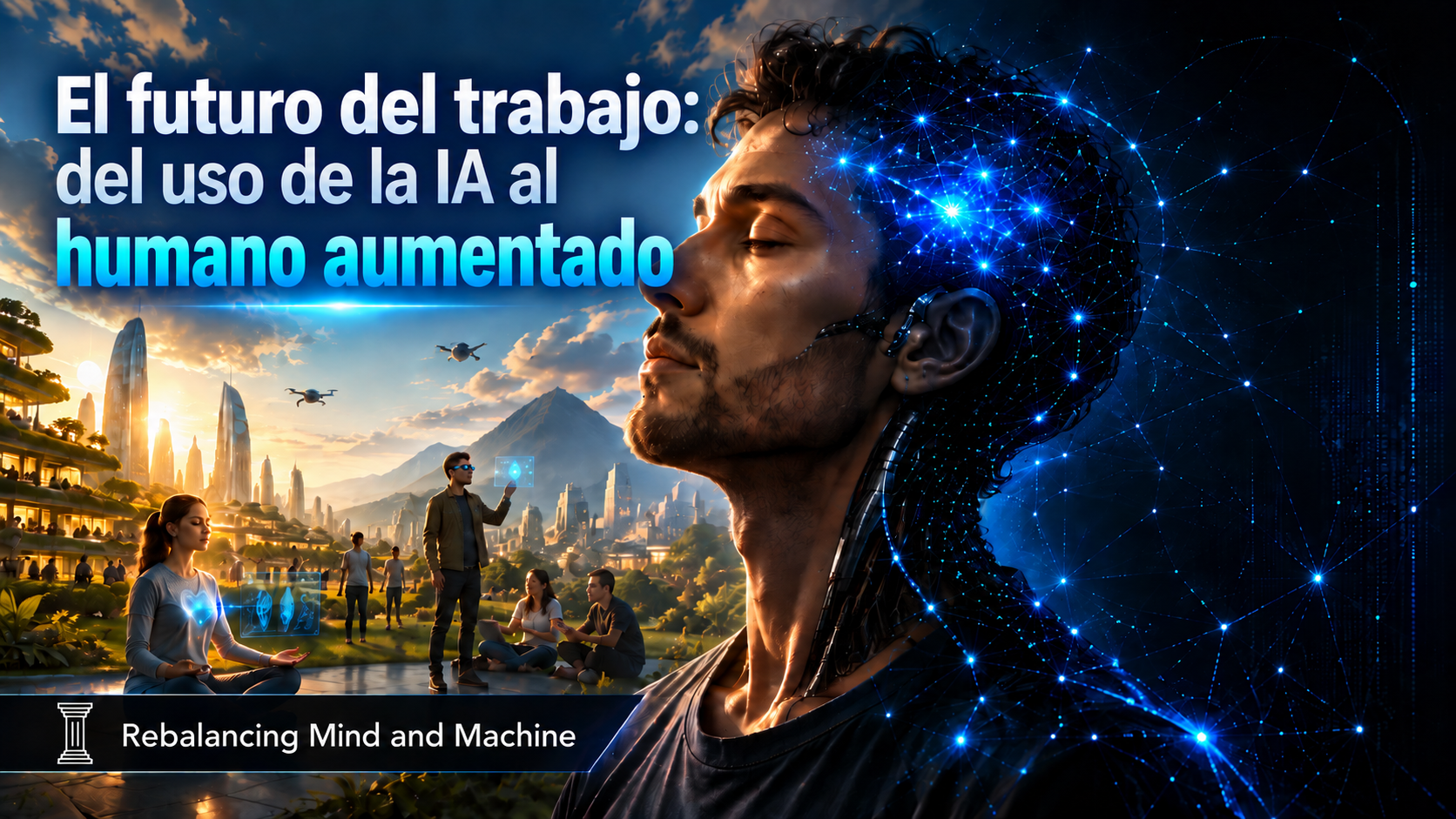
The Augmented Human
That is why I prefer to speak of the augmented human. I do not imagine the future as a simple competition between humans and machines. I see it as a process of rebalancing mind and machine. AI can expand available knowledge, accelerate creativity, improve certain decisions, increase productivity, and enable far more continuous learning. But judgment, purpose, responsibility, and contextual understanding remain profoundly human.
In the workplace, this leads to the augmented worker: a person who does not use AI merely to do faster what they were already doing, but to do things that were previously beyond their reach. The real change begins when we stop asking, “What task can I automate?” and start asking, “What new capability can I build?”
The Employer Must Change Too
The transformation cannot fall solely on the worker. Organizations also need to become augmented employers. It is not enough to provide tools and ask people to learn how to use them. Processes must be redesigned, institutional knowledge developed, data governed, experimentation and learning encouraged, and an architecture built in which people and artificial intelligence can work together.
Here we encounter one of the mistakes I observe most frequently: organizations that are buying AI instead of transforming work; training people to use tools instead of teaching them to understand AI; and renting external intelligence without developing enough intellectual capital of their own.
From Using AI to Building AI Capacity
This distinction will be strategic. An organization can consume artificial intelligence for years and remain completely dependent on third parties. Or it can use this stage to learn, identify opportunities, experiment, build its own knowledge, govern its data, and progressively move toward more specialized and controlled AI capabilities.
The question we should be asking, then, is not simply whether we are using artificial intelligence. The question is: are we building artificial intelligence capacity?
The future of work will probably not belong to those who simply have access to AI—that access will become increasingly abundant—but to the people and organizations capable of intelligently orchestrating people, processes, data, knowledge, and AI systems. A significant part of the new competitive advantage will lie there.
Technology will continue to advance. Tools will change. The models that seem extraordinary today will be replaced by others. But the capacity we build to think with AI, work with AI, and develop our own knowledge will remain.
That, for me, is the real challenge of the future of work: not simply learning to use artificial intelligence, but learning to grow with it.